
Paul McDougall - Chasing Horizons
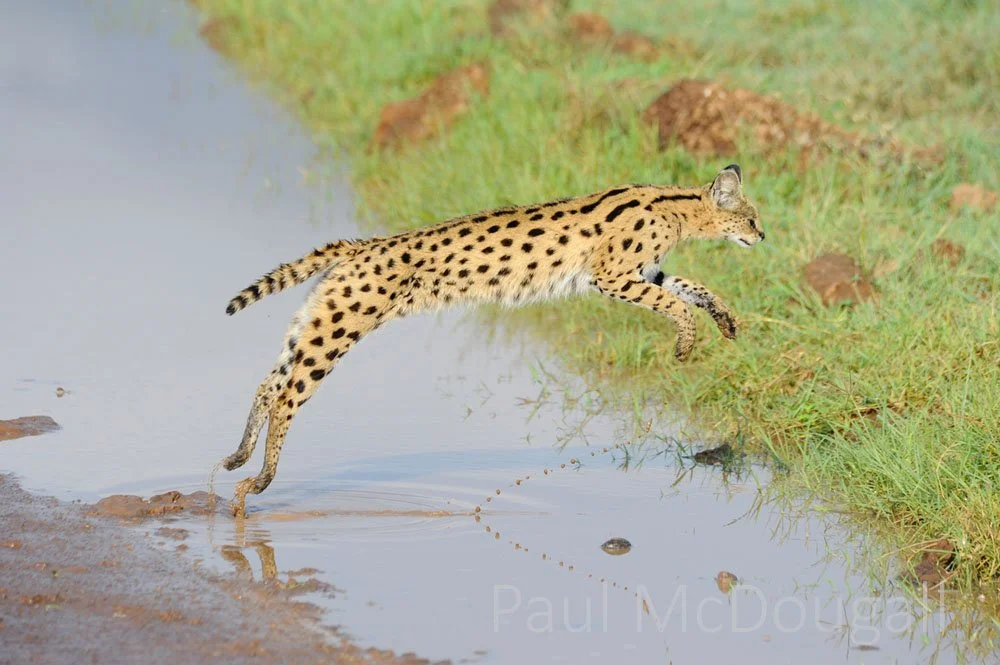
Serval Cat
Paul McDougall, a familiar and valued figure at Hamilton Camera Club, has seen remarkable success with his wildlife photography venture, McDougall Photographic. His business, which focuses on running specialised wildlife photography workshops and tours, has experienced significant growth over the past years. This success is evident in the sheer number of days dedicated to these events: this year he has conducted an impressive total of 139 days of workshops and 95 days of tours. This demanding schedule highlights Paul's dedication, the high demand for his expertise, and the quality of the experiences he offers to aspiring and experienced wildlife photographers alike. Paul encourages his mentees to create portfolios so that they don’t come away with just some outstanding photographs, but also a more rounded exploration of each subject and each environment.
Paul has created a framework of progression for exploring wildlife subjects: proof, document, narrative and vision. Proof represents the first encounter and simply demonstrates that the subject has been seen. Documenting the subject establishes its main features and environment. Narrative adds a story to the image, communicating what the subject has been doing, what it is doing and what it might do next. Finally the vision brings the creative representation of aspects such as lighting, motion and colour. Paul explained further that the plentiful opportunities his work affords him for photographing wildlife mean that he is more encouraged to take creative risks. Subsequently, our own Mike Farrance pointed out that the same principles can be applied to most if not all genres of photography, since we are all in danger of becoming jaded taking photographs of familiar subjects unless we take chances.
The structure of Paul’s presentation to the club at the start of December was essentially chronological, showcasing some outputs of his tours from January to November. Each month exhibited a diverse range of locations including Scotland, Kenya, Sri Lanka, Finland, South America and India, with subjects seemingly encompassing every large animal from gannets and bears to flying foxes and baboons Paul kept the images coming with dazzling rapidity, making it a challenge for me to scribble down even the country, let alone the specific settings and species covered by each section of the presentation.
Each photograph was helpfully accompanied by a small panel showing its principal metadata: camera, lens, aperture, shutter speed and exposure compensation. Paul’s favoured tools are a Nikon Z9, frequently accompanied by a 24-400mm lens. He will typically use a medium aperture around f7 or 8 but vary this for creative effects. Shutter speed is more critical, since he will approach each opportunity with a clear intention of the amount of freezing or blurring he wants, and isn’t afraid to go to extremes. Thus it varies between around ¼ second and 1/2000s or less. Auto-ISO picks up the slack when light is limited. Perhaps most interestingly, exposure compensation is varied in most cases, with zero compensation being the exception rather than the rule.
By increasing exposure, Paul achieves high key photographs where only the outlines of animals can be seen against a bright or even white background. More often, he underexposes such that the animal stands out clearly whilst the background dissolves into shade. It requires thoughtful composition to pull this off, of course, so that the photograph doesn’t just end up as a muddy grey. Another approach is using longer exposures, which in the bright sun of the Maasai Mara is not trivial, requiring low ISO and a lens stopped down as far as f45, but it enables creative techniques of panning, intentional camera movement (ICM) and “zoom burst”. Panning involves following the animal with the shutter open, so that the subject is sharp but the background is blurred. It requires a steady hand and a good instinct for anticipating the animal’s movements. Zoom burst is the technique of varying the zoom with the shutter open. The trick is to focus on the subject and give the zoom a quick twist to zoom in or out slightly within a longer exposure. The effect is of the animal being sharp but surrounded by a halo of dynamically blurred background elements.
It is truly a challenge to pick out highlights from this presentation when there was simply so much on offer, but here are a few. The Giraffe resting its chin on the rising sun. The cute beavers sharing a joke. Child elephants in the bosom of their family. Kingfishers in the rain. The elusive and elegant serval cat (Paul even joked about its elusiveness in the presentation since, although there were several great shots of it, never two together). The osprey, shown as a blur of feathers and claws around a pin-sharp eye and beak. For a real taste of the breadth and depth of Paul's work, visit his website and spend a few minutes browsing the many images on offer.