
Documentary Photography - Cameron Scott
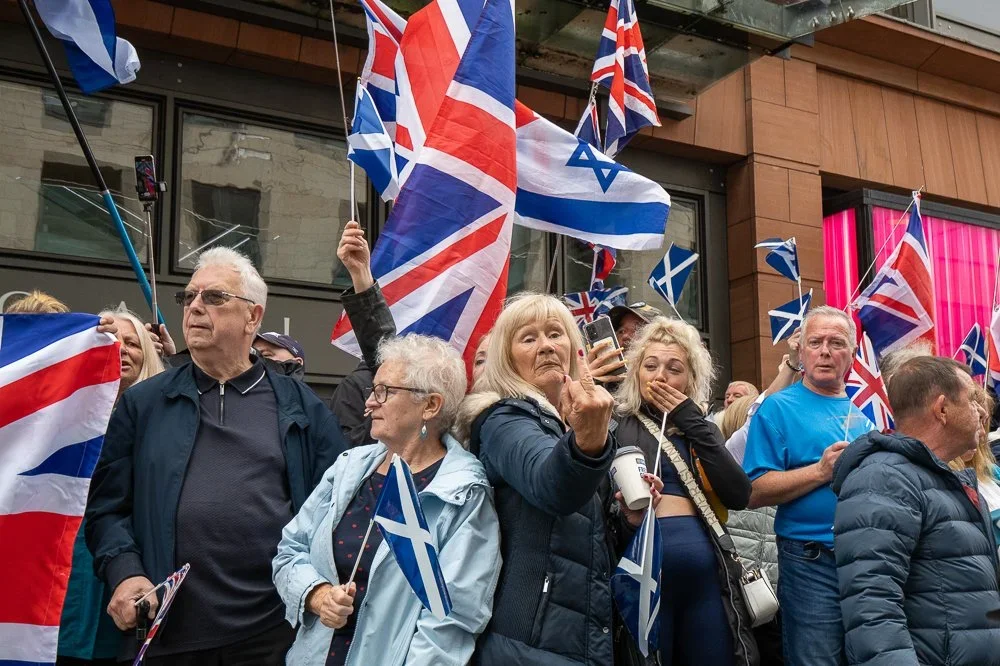
Cameron has visited Hamilton Camera Club several times as both a speaker and a judge. His talk in 2023 recounted his development from early steps at Wishaw High School, through club competitions and salons, and then into street and documentary photography. The focus of his 2026 talk was very much more on his recent documentary and photojournalism work.
Taking time to explain his views on the distinctions between genres and approaches, Cameron set out how the photography in club competitions tends towards the pictorial approach where the aim is to produce an appealing image which emphasises emotional resonance, mood, and personal artistic expression through use of light, colour and composition. Techniques such as the “rule of thirds”, complimentary colours and controlled bokeh are typically used.
By contrast, street photography tries to tell a story through a single image and documentary photojournalism builds an account of events, often through several images. It imposes a very different discipline to pictorial photography and carries ethical considerations. The aim is to record but not get directly involved or change the course of events. This is particularly challenging when, for example, far right groups are clashing with anti-racism protesters and a degree of trust has to be reached with both. Photographing people in sometimes violent and distressing circumstances needs sensitive attention to ensure that the dignity of subjects is not harmed and that their situation is not misrepresented or sensationalised.
Press agencies also set strict parameters: no adding, removing or cloning; minimal global adjustments, no local adjustments and minimal cropping. IPTC metadata covering items such as headline and location must be added using tools like Photo Mechanic, and captions must provide the 5 Ws: Who, What, Where, When, and Why. Speed is also essential as news outlets want to publish material within hours, or preferably minutes, of the events themselves.
As Cameron explained, composition is still essential, but by contrast with pictorial photography is often used to create a sense of imbalance, unease and dynamically changing events. Monochrome is generally favoured because it emphasises the structure and movement in a scene rather than its aesthetic qualities, but colour is sometimes used, for example to portray the drama of a sea of flags above a crowd. In either case the camera should be set up in the appropriate mode to help the photographer think in colour or black and white as they shoot.
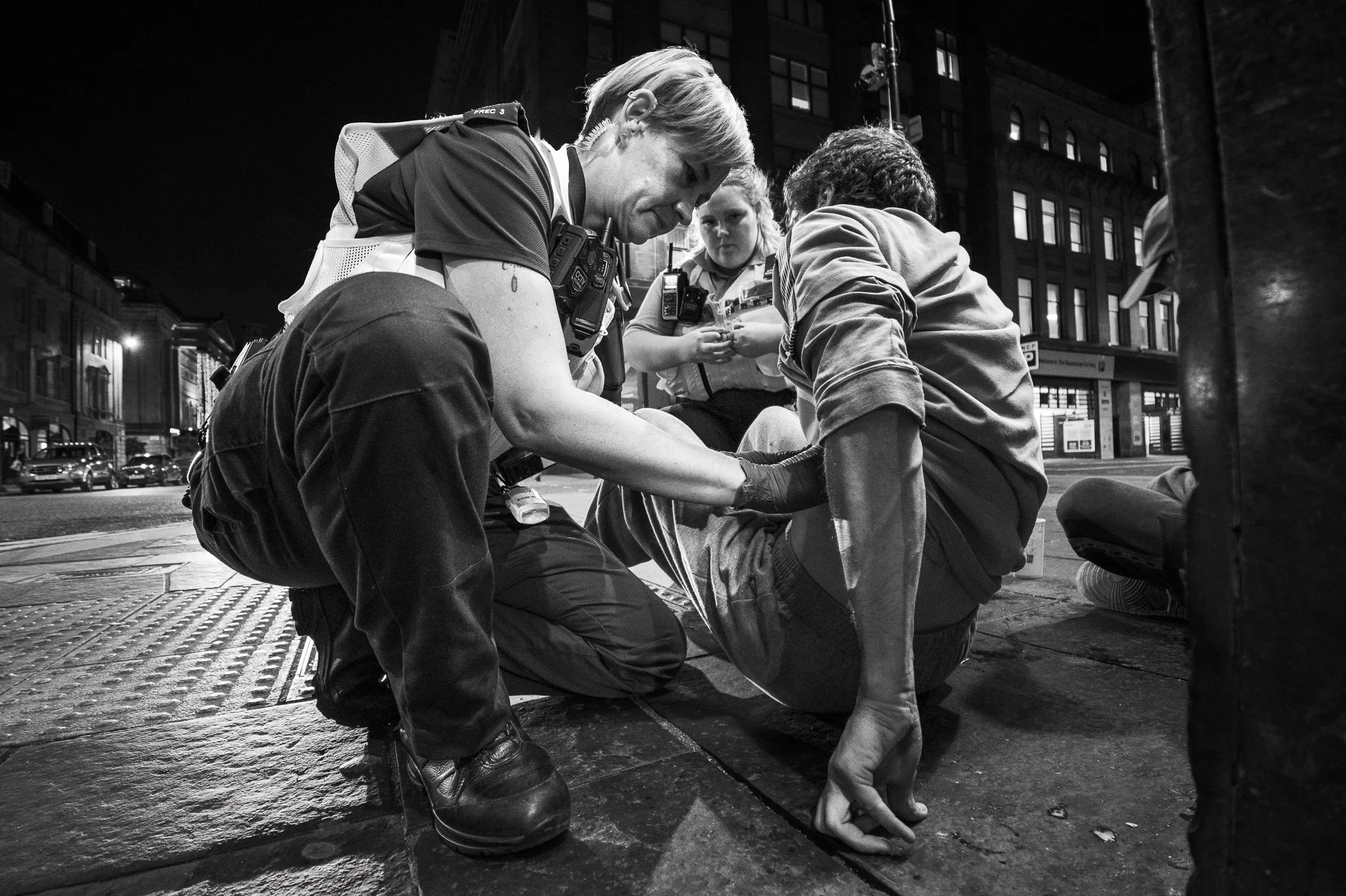
Elements which Cameron looks for in a scene are a full range of tones from pure white to pure black, and the inclusion of features which chime with each other. In one image, the glitter on a party cowboy hat is echoed in the glittery Barrowlands signage. In another, the epaulettes on two police uniforms form a natural vignette to the main subject of the scene. In yet another, a street medical worker aiding an intoxicated man has an illuminated star juxtapositioned behind her head like a saint’s halo. He usually seeks to include eyes, hands and mouths, since these carry the emotion of the scene, even though it means he sometimes finds himself having to walk backwards as a march moves forwards.
In terms of camera settings, simplicity is the key since the photographer must be fully conscious of and engaged with unfolding events. Cameron will often shoot at f4 and vary shutter speed as appropriate to the situation. He favours wide-angle lenses that enable him to get right in on the action whilst pulling in a lot of background context. He will often shoot in burst (or “machine gun”) mode, i.e. set the camera to take multiple frames per second, to increase the chances of getting the best shot, but tries not to go overboard since the review process then becomes too costly when time is of the essence. A typical shoot might yield 1 or 2 thousand images. He rarely uses noise reduction software, arguing that noise can be balanced by other adjustments and is a natural part of the image anyway.
Towards the end of the evening Cameron discussed another distinct aspect of his work - his involvement with Glasgow Street Aid. This is a medical and welfare charity offering on-the-spot care in Glasgow city centre. As a member of the charity he is able to document and promote their work, but working with a crew on the streets whilst attempting documentary photography isn’t always an easy balance to strike. There comes a point when the camera must be put away and the unfolding situation must be addressed. This is one case when the documentary photographer becomes part of the story.